PM 2.5: building the bridge between two state tests.
I developed a two-session Grade 7 ELA interim assessment to help the department identify next steps between state progress-monitoring windows. My work included blueprint planning, text and format selection, item writing, StudySync assembly, delivery coordination, and post-test review. It is a local, FAST-informed assessment—not an official state test.
Argument first. Cross-text thinking next.
A Patrick Henry speech anchors seven items. A paired-fiction block from Hatchet and The Adventures of Tom Sawyer follows with vocabulary, literary elements, perspective, and comparison tasks.
Craft, theme, and perspective.
This section contains a poem, a passage from Shane, and a passage from Tales of the Greek Heroes. Item types include selected-response, matrix, matching, and table formats.
Map the evidence before writing items.
I mapped 29 numbered items to 11 Florida B.E.S.T. benchmarks across informational text, prose, poetry, and paired reading in two assessment sessions.
Use state-style interactions with purpose.
The PDFs document multiple choice, five-option multiselect, EBSR, matching/table, and matrix tasks. Format variety is only useful when the task, evidence, benchmark, and scoring agree.
Turn item results into instructional decisions.
My résumé documents team review of difficulty with EBSR and multiselect formats. Teachers used the patterns to plan targeted review. Distinguishing a reading misconception from a response-format error is an important part of that work.
Twenty-nine numbered items. Two sessions. Eleven benchmarks in the blueprint.
The original planning map records benchmark allocations, item IDs, and formats: 14 numbered items on Day 1 and 15 on Day 2. The item-level review below examines what individual tasks actually measure.
| Standard | Day 1 item IDs | Day 2 item IDs | Total | Question types |
|---|---|---|---|---|
| 7.R.1.1 Plot, setting, character | 1-1.9, 1-1.11, 1-1.12 | 1-2.5 | 4 | MC; multiselect (2); drag-drop chart |
| 7.R.1.2 Theme | — | 1-2.6, 1-2.7 | 2 | MC; multiselect (2) |
| 7.R.1.3 POV / perspective | 1-1.10, 1-1.14 | 1-2.8 | 3 | EBSR; matching/table; MC |
| 7.R.1.4 Poetry | — | 1-2.1, 1-2.2, 1-2.3, 1-2.4 | 4 | Multiselect (2); MC; matrix/table |
| 7.R.2.1 Text structure | 1-1.2, 1-1.4, 1-1.5 | — | 3 | MC; multiselect (2) |
| 7.R.2.2 Central idea | 1-1.3 | 1-2.14 | 2 | EBSR; multiselect (2) |
| 7.R.2.3 Purpose / viewpoint | 1-1.6 | 1-2.12 | 2 | Multiselect (2); MC |
| 7.R.2.4 Argument | 1-1.1, 1-1.7 | — | 2 | MC; matching/table |
| 7.R.3.1 Figurative language / allusion | — | 1-2.10, 1-2.11, 1-2.15 | 3 | EBSR; multiselect (2); drag-drop chart |
| 7.R.3.3 Compare / contrast | 1-1.13 | — | 1 | MC |
| 7.V.1.3 Vocabulary in context | 1-1.8 | 1-2.9, 1-2.13 | 3 | MC |
The blueprint records intended coverage. A/B parts and matrix cells are not counted as additional numbered items, and response format alone does not determine cognitive rigor.
Blueprint and printed benchmark labels
The original blueprint maps 11 intended benchmarks. The administered PDFs visibly print 10 distinct benchmark suffixes because the poetry block’s intended 7.R.1.4 allocation is not consistently printed on the item pages. The blueprint records the plan; the saved item pages show what students actually saw.
Selected item-level audit
| Item | Blueprint standard | Passage / set | Format | Demand visible in task* | Session |
|---|---|---|---|---|---|
| 1-1.2 | 7.R.2.1 | Patrick Henry speech | Four-choice MC | Explain a paragraph’s purpose | 1 |
| 1-1.3 | 7.R.2.2 | Patrick Henry speech | EBSR · A/B | Identify one idea and support; component task, not comparison of two ideas | 1 |
| 1-1.6 | 7.R.2.3 | Patrick Henry speech | Five-option multiselect · choose two | Interpret diction and viewpoint; syntax not established by this audit | 1 |
| 1-1.7 | 7.R.2.4 | Patrick Henry speech | Matching / table | Connect claim and support; effectiveness of reasoning not established | 1 |
| 1-1.12 | 7.R.1.1 | Paired-fiction block | Drag-and-drop table | Relate setting to reaction and change | 1 |
| 1-2.3 | 7.R.1.4 Poetry | “Acquainted with the Night” | Matrix · one response per row | Interpret language and emotional effect; impact of poetic form not established | 2 |
| 1-2.8 | 7.R.1.3 | Shane | Matching | Connect narrative choice with reader effect | 2 |
| 1-2.15 | 7.R.3.1 | Tales of the Greek Heroes | Matching / table | Connect allusion, reference, and effect | 2 |
*Demand descriptions are portfolio review judgments, not recovered difficulty ratings. These IDs map the saved two-session PDFs; the Susan B. Anthony item samples below are also part of the PM 2.5 project.
One item from the classroom assessment.
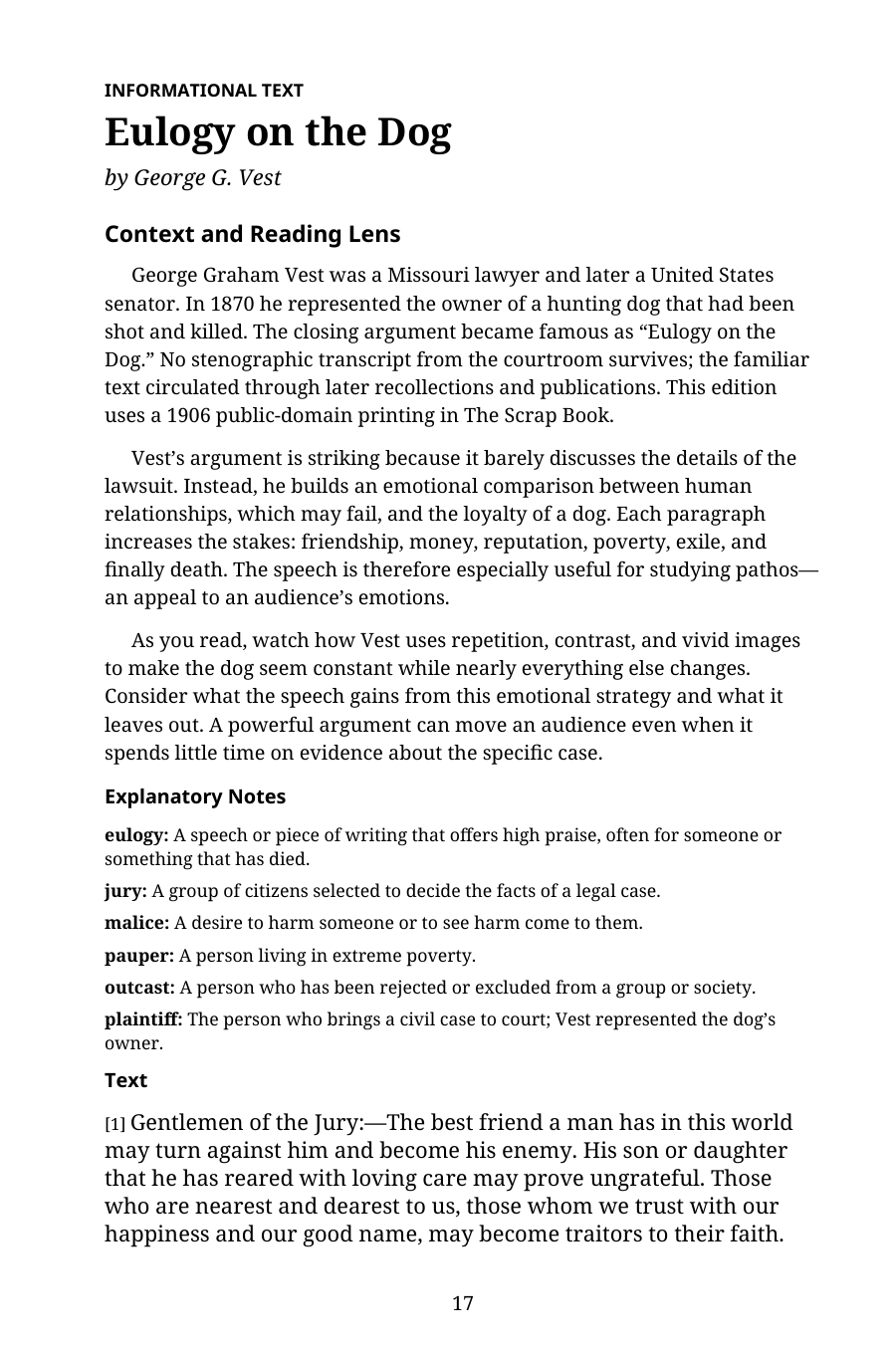
The item below and its response options are transcribed from the saved Day 1 assessment. The passage is Patrick Henry’s “Liberty or Death” speech; this is its first paragraph, which students read before answering.
No man thinks more highly than I do of the patriotism, as well as abilities, of the very worthy gentlemen who have just addressed the House. But different men often see the same subject in different lights; and, therefore, I hope it will not be thought disrespectful to those gentlemen if, entertaining as I do opinions of a character very opposite to theirs, I shall speak forth my sentiments freely and without reserve. This is no time for ceremony. The question before the House is one of awful moment to this country. For my own part, I consider it as nothing less than a question of freedom or slavery.
Printed standard: 7.R.2.1 · Structure
What is the purpose of Paragraph 1 in the passage?
Task and format. Students explain what the opening section does in Henry’s argument. A four-choice item gives one defensible purpose and three competing readings of the paragraph.
Editorial reading: C. “This is no time for ceremony” and “a question of freedom or slavery” establish both bluntness and urgency. This is a portfolio analysis of the saved item, not a recovered answer key.
Distractor review. A and B name content absent from the paragraph; D overreads Henry’s respectful opening as praise for negotiations. A future revision could make the wrong options closer to actual rhetorical functions while preserving a single key.
Access and fairness. The answer rests on the paragraph itself. For digital delivery, keep the passage and options readable with keyboard and screen-reader navigation; no outside historical knowledge is needed to choose C.
Read the item. Inspect the decisions.
These four Susan B. Anthony items are part of the PM 2.5 project. The notes make their benchmarks, text evidence, distractors, accessibility, and scoring decisions inspectable.
Read the shared source text: Susan B. Anthony’s 1873 address
Public-domain excerpt from Anthony’s address delivered before her 1873 trial for voting. Paragraph numbers help readers refer to the text. Source: Project Gutenberg, An Account of the Proceedings on the Trial of Susan B. Anthony.
[1] Friends and Fellow-citizens: I stand before you to-night, under indictment for the alleged crime of having voted at the last Presidential election, without having a lawful right to vote. It shall be my work this evening to prove to you that in thus voting, I not only committed no crime, but, instead, simply exercised my citizen’s right, guaranteed to me and all United States citizens by the National Constitution, beyond the power of any State to deny.
[2] Our democratic-republican government is based on the idea of the natural right of every individual member thereof to a voice and a vote in making and executing the laws. We assert the province of government to be to secure the people in the enjoyment of their unalienable rights. We throw to the winds the old dogma that governments can give rights.
[3] And when 100 or 1,000,000 people enter into a free government, they do not barter away their natural rights; they simply pledge themselves to protect each other in the enjoyment of them, through prescribed judicial and legislative tribunals.
01 · Multiple choice — paragraph purpose · PM 2.5 item
How does paragraph 1 contribute to the development of Anthony’s argument?
Benchmark and skill. ELA.7.R.2.1 asks how an individual section conveys a purpose. Students identify what the opening does within Anthony’s argument.
Format and distractors. Each option proposes a function for the introduction. A invents official approval, B introduces absent content, and C invents praise.
Portfolio key: D. Anthony names the accusation and immediately states the contrary claim she will defend.
Accessibility and fairness. The supplied excerpt contains the necessary context. Prior knowledge of Anthony or constitutional amendments is not required.
02 · EBSR — central idea and support · PM 2.5 item
Part A: Which central idea is developed across the excerpt?
Part B: Which quotation most directly supports the answer to Part A?
Benchmark and skill. ELA.7.R.2.2: students identify a central idea in Anthony’s argument and select the quotation that supports it most directly.
Why EBSR. Part A measures interpretation; Part B asks for the most direct support rather than a merely related line.
Review key: A / B. Anthony argues that rights precede government and that government secures them. Part B’s A is plausible because it names a natural right, but B states the government-rights relationship most directly.
Scoring and review. Scoring the two decisions separately can distinguish interpretation from evidence selection.
03 · Five-option multiselect — diction and syntax · PM 2.5 item
Which two choices explain how Anthony’s word choice and sentence structure advance her persuasive purpose? Select two answers.
Benchmark and skill. ELA.7.R.2.3 asks how diction and syntax work to achieve an author’s purpose. A examines Anthony’s “not only ... but” contrast; C examines her choice of “secure” versus “give.”
Why multiselect. Students must select one explanation of sentence arrangement and one of word choice. B reverses her rights claim; D misreads the role of courts; E mistakes an address for neutral reporting.
Portfolio key: A and C. Both choices connect a specific language decision to her attempt to rebut the charge and persuade the audience.
Accessibility and scoring. “Select two” is stated in text. A digital version should use labeled checkboxes. Proposed score: one point only for A and C with no extra selection.
04 · Matching table — argument development and reasoning · PM 2.5 item
The text supplies the reasoning steps; the task asks students to evaluate what each step establishes and where its support stops.
Directions: Match each step of Anthony’s argument to the evaluation that best explains its contribution and limitation. Use each choice at most once; one choice will not be used.
| Reasoning step in the excerpt | Evaluation choice |
|---|---|
| Paragraph 1: voting was an exercise of a citizen’s right, not a crime. | ___ |
| Paragraph 2: government exists to “secure” rights, not to “give” them. | ___ |
| Paragraph 3: people entering a government “do not barter away their natural rights.” | ___ |
Benchmark and format. ELA.7.R.2.4 asks students to track argument development and analyze the effectiveness of reasoning. The table follows Anthony’s progression from her vote, to a rights premise, to what citizens retain in government.
Choice construction. Each evaluation states what a step contributes and, where appropriate, what it does not establish. D is an unsupported inference; the other choices require attention to the scope of each claim.
Review key: B / C / A; D unused. The three rows each require a separate decision; the unused option tests whether students confuse assertion with proof.
Accessibility and fairness. A digital version should use keyboard-operable select controls and allow each option to be read with every row. Students evaluate the reasoning, not the political position.
A benchmark label is the start of review—not the finish.
This portfolio checklist makes the review criteria explicit. It is a current demonstration of the workflow, not a claim that a dated checklist accompanied the original administration.
- Alignment: check the grade, benchmark action, scope, and actual student task.
- Evidence: locate support for every keyed response; explain why alternatives fail.
- Rigor: distinguish recall, interpretation, and analysis; do not equate format with demand.
- Accuracy and rights: verify quotations, attributions, permissions, facts, and internal references.
- Response options: review plausible misconceptions, parallel wording, answer-position patterns, and unintended cues. Use a consistent ordering principle when it helps students scan the choices.
- Accessibility: review directions, reading load, contrast, labels, keyboard access, and applicable accommodations.
- Fairness: remove unnecessary background knowledge and stereotypes; distinguish analysis from endorsement.
- Scoring: define keys, partial-credit rules, point totals, reviewer sign-off, and revision history.
Alternative item design: examine related ideas
PM 2.5 EBSR above: “Which central idea is developed across the excerpt?” Students identify an idea and select direct support.
Additional editorial variant: Read the Susan B. Anthony excerpt above. How do Anthony’s ideas about citizens’ natural rights and government’s role develop together across paragraphs 1–3?
Proposed key: A. The correct response traces both ideas from Anthony’s defense in paragraph 1 through her rights premise in paragraph 2 and her account of retained rights in paragraph 3. B and C reverse her claims; D severs the relationship she develops. The shared source lets a reviewer inspect this revision. It remains an unpiloted portfolio item.
Text complexity, AI support, and human review
Review a passage’s language, syntax, structure, background-knowledge demands, and relationship to the task alongside quantitative measures when available. No verified Lexile range or formal cognitive-demand distribution is claimed for these PDFs.
My October résumé describes AI-supported drafting with human checks for source fidelity, answer logic, alignment, bias, and appropriateness. The examples here show why those checks matter: an authentic saved item can still need revision. AI output is a draft, not evidence that a passage is authentic or an answer is defensible.
Benchmark reference: Florida B.E.S.T. ELA standards (PDF). Standards are summarized in the review notes; the source controls their full wording.
Shared work. Carefully bounded claims.
My contribution was assessment development and collaborative review. The department’s work included instruction, analysis, and reteaching. School reports show aggregate grade groups moving from 51% proficient in Grade 6 to 55% in Grade 7, and from 50% in Grade 7 to 57% in Grade 8. Across those comparisons, Level 1 fell by 10 points for the incoming Grade 7 group and by 6 points for the incoming Grade 8 group. The four reports include 258–294 students, so these are grade-group comparisons rather than matched-student growth. They do not establish that PM 2.5 caused the changes.
Both school results confirmed
Both school results confirmed