ELA Curriculum & Assessment Development Specialist

I build ELA assessments and curriculum ready for use.

I’m Benjamin Andersen. I bring 15+ years in education, department leadership, and six years in journalism to standards mapping, item writing, editorial review, and instructional content for educators and content teams.

Assessment blueprintCurriculum systemPublished readers

01 / ASSESSMENT

Evidence before adjectives.

Inspect the assessment, the reasoning behind the items, and the review decisions. This is classroom-developed work, with the evidence and its limits made visible.

Assessment design case study

PM 2.5: building the bridge between two state tests.

I developed a two-session Grade 7 ELA interim assessment to help the department identify next steps between state progress-monitoring windows. My work included blueprint planning, text and format selection, item writing, StudySync assembly, delivery coordination, and post-test review. It is a local, FAST-informed assessment—not an official state test.

29numbered items across two sessions
2assessment sessions · 14 + 15 items
6passages across the assessment
5reading blocks · one contains paired passages
Day 1 · Informational + comparative

Argument first. Cross-text thinking next.

A Patrick Henry speech anchors seven items. A paired-fiction block from Hatchet and The Adventures of Tom Sawyer follows with vocabulary, literary elements, perspective, and comparison tasks.

R.2.4 ArgumentR.2.1 StructureR.2.2 Central IdeaR.2.3 PurposeV.1.3 VocabularyR.1.1 Literary ElementsR.1.3 Point of ViewR.3.3 Comparative Reading
Day 2 · Poetry + fiction + myth

Craft, theme, and perspective.

This section contains a poem, a passage from Shane, and a passage from Tales of the Greek Heroes. Item types include selected-response, matrix, matching, and table formats.

R.1.4 PoetryR.3.1 Figurative LanguageR.1.1 Literary ElementsR.1.2 ThemeR.1.3 Point of ViewR.2.2 Central IdeaR.2.3 PurposeV.1.3 Vocabulary
01 · BLUEPRINT

Map the evidence before writing items.

I mapped 29 numbered items to 11 Florida B.E.S.T. benchmarks across informational text, prose, poetry, and paired reading in two assessment sessions.

02 · BUILD + REVIEW

Use state-style interactions with purpose.

The PDFs document multiple choice, five-option multiselect, EBSR, matching/table, and matrix tasks. Format variety is only useful when the task, evidence, benchmark, and scoring agree.

03 · RESPOND

Turn item results into instructional decisions.

My résumé documents team review of difficulty with EBSR and multiselect formats. Teachers used the patterns to plan targeted review. Distinguishing a reading misconception from a response-format error is an important part of that work.

Inspectable evidence · original blueprint

Twenty-nine numbered items. Two sessions. Eleven benchmarks in the blueprint.

The original planning map records benchmark allocations, item IDs, and formats: 14 numbered items on Day 1 and 15 on Day 2. The item-level review below examines what individual tasks actually measure.

Original PM 2.5 test blueprint
StandardDay 1 item IDsDay 2 item IDsTotalQuestion types
7.R.1.1
Plot, setting, character
1-1.9, 1-1.11, 1-1.121-2.54MC; multiselect (2); drag-drop chart
7.R.1.2
Theme
—1-2.6, 1-2.72MC; multiselect (2)
7.R.1.3
POV / perspective
1-1.10, 1-1.141-2.83EBSR; matching/table; MC
7.R.1.4
Poetry
—1-2.1, 1-2.2, 1-2.3, 1-2.44Multiselect (2); MC; matrix/table
7.R.2.1
Text structure
1-1.2, 1-1.4, 1-1.5—3MC; multiselect (2)
7.R.2.2
Central idea
1-1.31-2.142EBSR; multiselect (2)
7.R.2.3
Purpose / viewpoint
1-1.61-2.122Multiselect (2); MC
7.R.2.4
Argument
1-1.1, 1-1.7—2MC; matching/table
7.R.3.1
Figurative language / allusion
—1-2.10, 1-2.11, 1-2.153EBSR; multiselect (2); drag-drop chart
7.R.3.3
Compare / contrast
1-1.13—1MC
7.V.1.3
Vocabulary in context
1-1.81-2.9, 1-2.133MC

The blueprint records intended coverage. A/B parts and matrix cells are not counted as additional numbered items, and response format alone does not determine cognitive rigor.

Blueprint and printed benchmark labels

The original blueprint maps 11 intended benchmarks. The administered PDFs visibly print 10 distinct benchmark suffixes because the poetry block’s intended 7.R.1.4 allocation is not consistently printed on the item pages. The blueprint records the plan; the saved item pages show what students actually saw.

Selected item-level audit
Representative items checked against the administered PDFs
ItemBlueprint standardPassage / setFormatDemand visible in task*Session
1-1.27.R.2.1Patrick Henry speechFour-choice MCExplain a paragraph’s purpose1
1-1.37.R.2.2Patrick Henry speechEBSR · A/BIdentify one idea and support; component task, not comparison of two ideas1
1-1.67.R.2.3Patrick Henry speechFive-option multiselect · choose twoInterpret diction and viewpoint; syntax not established by this audit1
1-1.77.R.2.4Patrick Henry speechMatching / tableConnect claim and support; effectiveness of reasoning not established1
1-1.127.R.1.1Paired-fiction blockDrag-and-drop tableRelate setting to reaction and change1
1-2.37.R.1.4
Poetry
“Acquainted with the Night”Matrix · one response per rowInterpret language and emotional effect; impact of poetic form not established2
1-2.87.R.1.3ShaneMatchingConnect narrative choice with reader effect2
1-2.157.R.3.1Tales of the Greek HeroesMatching / tableConnect allusion, reference, and effect2

*Demand descriptions are portfolio review judgments, not recovered difficulty ratings. These IDs map the saved two-session PDFs; the Susan B. Anthony item samples below are also part of the PM 2.5 project.

Original administered work · Day 1, item 1-1.2

One item from the classroom assessment.

The item below and its response options are transcribed from the saved Day 1 assessment. The passage is Patrick Henry’s “Liberty or Death” speech; this is its first paragraph, which students read before answering.

No man thinks more highly than I do of the patriotism, as well as abilities, of the very worthy gentlemen who have just addressed the House. But different men often see the same subject in different lights; and, therefore, I hope it will not be thought disrespectful to those gentlemen if, entertaining as I do opinions of a character very opposite to theirs, I shall speak forth my sentiments freely and without reserve. This is no time for ceremony. The question before the House is one of awful moment to this country. For my own part, I consider it as nothing less than a question of freedom or slavery.

Printed standard: 7.R.2.1 · Structure

What is the purpose of Paragraph 1 in the passage?
  1. To explain the legal procedures of the Virginia House of Burgesses.
  2. To provide a historical summary of the conflict with the British ministry.
  3. To establish the urgency of the situation and the speaker's intent to be blunt.
  4. To congratulate the previous speakers on their successful negotiations against war.

Task and format. Students explain what the opening section does in Henry’s argument. A four-choice item gives one defensible purpose and three competing readings of the paragraph.

Editorial reading: C. “This is no time for ceremony” and “a question of freedom or slavery” establish both bluntness and urgency. This is a portfolio analysis of the saved item, not a recovered answer key.

Distractor review. A and B name content absent from the paragraph; D overreads Henry’s respectful opening as praise for negotiations. A future revision could make the wrong options closer to actual rhetorical functions while preserving a single key.

Access and fairness. The answer rests on the paragraph itself. For digital delivery, keep the passage and options readable with keyboard and screen-reader navigation; no outside historical knowledge is needed to choose C.

PM 2.5 item samples · four response formats

Read the item. Inspect the decisions.

These four Susan B. Anthony items are part of the PM 2.5 project. The notes make their benchmarks, text evidence, distractors, accessibility, and scoring decisions inspectable.

Read the shared source text: Susan B. Anthony’s 1873 address

Public-domain excerpt from Anthony’s address delivered before her 1873 trial for voting. Paragraph numbers help readers refer to the text. Source: Project Gutenberg, An Account of the Proceedings on the Trial of Susan B. Anthony.

[1] Friends and Fellow-citizens: I stand before you to-night, under indictment for the alleged crime of having voted at the last Presidential election, without having a lawful right to vote. It shall be my work this evening to prove to you that in thus voting, I not only committed no crime, but, instead, simply exercised my citizen’s right, guaranteed to me and all United States citizens by the National Constitution, beyond the power of any State to deny.

[2] Our democratic-republican government is based on the idea of the natural right of every individual member thereof to a voice and a vote in making and executing the laws. We assert the province of government to be to secure the people in the enjoyment of their unalienable rights. We throw to the winds the old dogma that governments can give rights.

[3] And when 100 or 1,000,000 people enter into a free government, they do not barter away their natural rights; they simply pledge themselves to protect each other in the enjoyment of them, through prescribed judicial and legislative tribunals.

01 · Multiple choice — paragraph purpose · PM 2.5 item
How does paragraph 1 contribute to the development of Anthony’s argument?
  1. By recounting the complete history of the election, it proves that officials approved Anthony’s ballot before she voted.
  2. By describing the Constitution’s amendment process, it explains how voting qualifications can legally change.
  3. By praising the audience’s patriotism, it creates agreement before she introduces a controversial proposal.
  4. By identifying the accusation and her opposing claim, it establishes the central dispute she will address.

Benchmark and skill. ELA.7.R.2.1 asks how an individual section conveys a purpose. Students identify what the opening does within Anthony’s argument.

Format and distractors. Each option proposes a function for the introduction. A invents official approval, B introduces absent content, and C invents praise.

Portfolio key: D. Anthony names the accusation and immediately states the contrary claim she will defend.

Accessibility and fairness. The supplied excerpt contains the necessary context. Prior knowledge of Anthony or constitutional amendments is not required.

02 · EBSR — central idea and support · PM 2.5 item
Part A: Which central idea is developed across the excerpt?
  1. A legitimate government protects the natural rights citizens already possess instead of creating or granting those rights as privileges.
  2. Governments may limit political participation whenever citizens disagree about how natural rights should be protected.
  3. Citizens surrender their natural rights when they create courts and legislatures to resolve public disagreements.
  4. Voting becomes a protected right only after a state formally adds that protection to its constitution.
Part B: Which quotation most directly supports the answer to Part A?
  1. “Our democratic-republican government is based on the idea of the natural right of every individual member thereof...”
  2. “We assert the province of government to be to secure the people in the enjoyment of their unalienable rights.”
  3. “It shall be my work this evening to prove to you that in thus voting, I not only committed no crime...”
  4. “they do not barter away their natural rights; they simply pledge themselves to protect each other...”

Benchmark and skill. ELA.7.R.2.2: students identify a central idea in Anthony’s argument and select the quotation that supports it most directly.

Why EBSR. Part A measures interpretation; Part B asks for the most direct support rather than a merely related line.

Review key: A / B. Anthony argues that rights precede government and that government secures them. Part B’s A is plausible because it names a natural right, but B states the government-rights relationship most directly.

Scoring and review. Scoring the two decisions separately can distinguish interpretation from evidence selection.

03 · Five-option multiselect — diction and syntax · PM 2.5 item
Which two choices explain how Anthony’s word choice and sentence structure advance her persuasive purpose? Select two answers.
  1. By pairing “not only committed no crime” with “but, instead, simply exercised my citizen’s right,” she turns the accusation into a claim of entitlement.
  2. By calling voting an “alleged crime,” she accepts that officials may grant or remove natural rights whenever they choose.
  3. By contrasting “secure” with “give,” she argues that government protects rights it did not create.
  4. By naming courts and legislatures, she argues that voters should give up direct participation.
  5. By greeting the audience, she presents a neutral report rather than an argument.

Benchmark and skill. ELA.7.R.2.3 asks how diction and syntax work to achieve an author’s purpose. A examines Anthony’s “not only ... but” contrast; C examines her choice of “secure” versus “give.”

Why multiselect. Students must select one explanation of sentence arrangement and one of word choice. B reverses her rights claim; D misreads the role of courts; E mistakes an address for neutral reporting.

Portfolio key: A and C. Both choices connect a specific language decision to her attempt to rebut the charge and persuade the audience.

Accessibility and scoring. “Select two” is stated in text. A digital version should use labeled checkboxes. Proposed score: one point only for A and C with no extra selection.

04 · Matching table — argument development and reasoning · PM 2.5 item

The text supplies the reasoning steps; the task asks students to evaluate what each step establishes and where its support stops.

Directions: Match each step of Anthony’s argument to the evaluation that best explains its contribution and limitation. Use each choice at most once; one choice will not be used.

  1. It extends the rights principle to people who form a government, but does not by itself establish a specific voting law.
  2. It asserts a constitutional right as her defense, but does not yet show why the charge against her is legally mistaken.
  3. It supports her claim that rights precede government by contrasting protection with government-created rights.
  4. It proves election officials approved her ballot before she voted.
Reasoning step in the excerptEvaluation choice
Paragraph 1: voting was an exercise of a citizen’s right, not a crime.___
Paragraph 2: government exists to “secure” rights, not to “give” them.___
Paragraph 3: people entering a government “do not barter away their natural rights.”___

Benchmark and format. ELA.7.R.2.4 asks students to track argument development and analyze the effectiveness of reasoning. The table follows Anthony’s progression from her vote, to a rights premise, to what citizens retain in government.

Choice construction. Each evaluation states what a step contributes and, where appropriate, what it does not establish. D is an unsupported inference; the other choices require attention to the scope of each claim.

Review key: B / C / A; D unused. The three rows each require a separate decision; the unused option tests whether students confuse assertion with proof.

Accessibility and fairness. A digital version should use keyboard-operable select controls and allow each option to be read with every row. Students evaluate the reasoning, not the political position.

Editorial quality assurance

A benchmark label is the start of review—not the finish.

This portfolio checklist makes the review criteria explicit. It is a current demonstration of the workflow, not a claim that a dated checklist accompanied the original administration.

  • Alignment: check the grade, benchmark action, scope, and actual student task.
  • Evidence: locate support for every keyed response; explain why alternatives fail.
  • Rigor: distinguish recall, interpretation, and analysis; do not equate format with demand.
  • Accuracy and rights: verify quotations, attributions, permissions, facts, and internal references.
  • Response options: review plausible misconceptions, parallel wording, answer-position patterns, and unintended cues. Use a consistent ordering principle when it helps students scan the choices.
  • Accessibility: review directions, reading load, contrast, labels, keyboard access, and applicable accommodations.
  • Fairness: remove unnecessary background knowledge and stereotypes; distinguish analysis from endorsement.
  • Scoring: define keys, partial-credit rules, point totals, reviewer sign-off, and revision history.
Alternative item design: examine related ideas

PM 2.5 EBSR above: “Which central idea is developed across the excerpt?” Students identify an idea and select direct support.

Additional editorial variant: Read the Susan B. Anthony excerpt above. How do Anthony’s ideas about citizens’ natural rights and government’s role develop together across paragraphs 1–3?

  1. She defends her vote as a citizen’s right, argues that government secures rather than gives rights, and explains that people retain those rights when they form a government.
  2. She defends the government’s control over voting, then says citizens must surrender natural rights to receive legal protection.
  3. She describes voting as a crime, but later accepts that courts may create new rights for citizens who obey the law.
  4. She treats voting and government as unrelated, then favors private action over shared legal protection.

Proposed key: A. The correct response traces both ideas from Anthony’s defense in paragraph 1 through her rights premise in paragraph 2 and her account of retained rights in paragraph 3. B and C reverse her claims; D severs the relationship she develops. The shared source lets a reviewer inspect this revision. It remains an unpiloted portfolio item.

Text complexity, AI support, and human review

Review a passage’s language, syntax, structure, background-knowledge demands, and relationship to the task alongside quantitative measures when available. No verified Lexile range or formal cognitive-demand distribution is claimed for these PDFs.

My October résumé describes AI-supported drafting with human checks for source fidelity, answer logic, alignment, bias, and appropriateness. The examples here show why those checks matter: an authentic saved item can still need revision. AI output is a draft, not evidence that a passage is authentic or an answer is defensible.

Benchmark reference: Florida B.E.S.T. ELA standards (PDF). Standards are summarized in the review notes; the source controls their full wording.

DEPARTMENT CONTEXT · REPORTED OUTCOMES

Shared work. Carefully bounded claims.

My contribution was assessment development and collaborative review. The department’s work included instruction, analysis, and reteaching. School reports show aggregate grade groups moving from 51% proficient in Grade 6 to 55% in Grade 7, and from 50% in Grade 7 to 57% in Grade 8. Across those comparisons, Level 1 fell by 10 points for the incoming Grade 7 group and by 6 points for the incoming Grade 8 group. The four reports include 258–294 students, so these are grade-group comparisons rather than matched-student growth. They do not establish that PM 2.5 caused the changes.

51→55%Grade 6 to Grade 7 · +4 points
Both school results confirmed
50→57%Grade 7 to Grade 8 · +7 points
Both school results confirmed
02 / SELECTED WORK

Built for real classrooms.

My work sits at the intersection of content expertise, editorial judgment, assessment quality, and day-to-day usability. The completed case studies below show both the thinking and the finished product.

Assessment design

Florida B.E.S.T.-mapped ELA item sets

Multiple-choice, multiselect, and evidence-based selected-response tasks with item-level notes on benchmark scope, text evidence, distractors, accessibility, and scoring.

View completed case study
Curriculum systems

Text-centered literacy units

Multiweek units connecting complex texts, analytical writing, vocabulary, discussion, formative checks, and differentiated supports for Grades 6–8.

View completed case study
Publishing

Classic Literature Readers

Publication-ready literature collections developed through text selection, standards mapping, editing, annotation, accessibility review, page design, and production QA.

View completed case study
Data & response

Interim assessment cycle

Assessment development and collaborative analysis, with reported department outcomes clearly separated from claims of causation.

See the full assessment cycle
Quality assurance

Content review workflow

Review for alignment, rigor, evidence, accessibility, distractor quality, scoring accuracy, internal consistency, and publication-ready formatting.

Inspect review checklist and revision
Professional learning

Teacher-facing guidance

Clear, practical facilitation and documentation that helps educators understand standards, interpret student evidence, and act on results.

Explore original learning projects
Curriculum systems case study

Reading becomes talk. Talk becomes evidence.

A daily protocol for a Grade 8 reading of The Call of the Wild turns a short, manageable reading assignment into a sequence of close reading, collaborative sense-making, and independent evidence of learning.

Teacher handoff sample: a 45-minute Day 4 lesson with reading and discussion directions, five independent-check items, key notes, access supports, and a suggested response to common misconceptions.

Download Day 4 teacher sample (PDF)
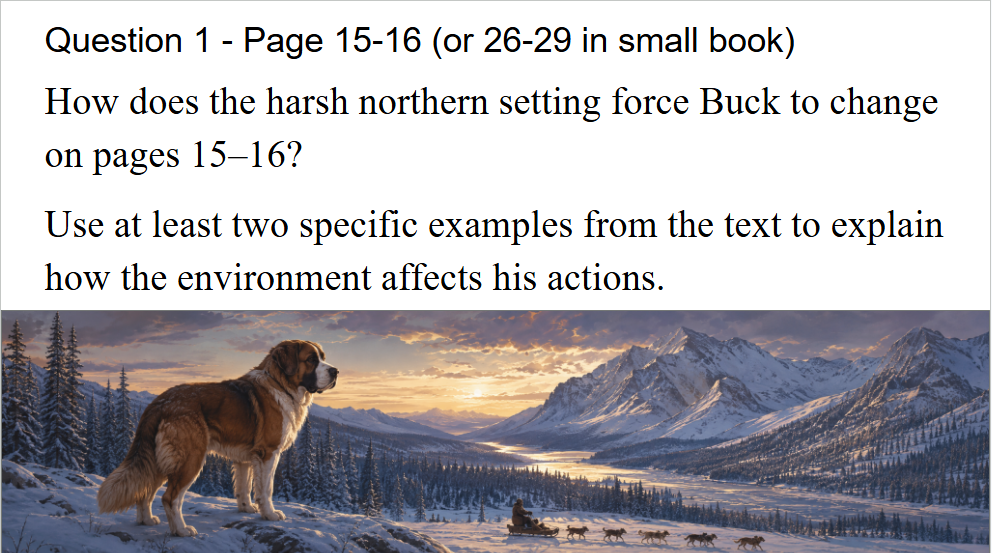
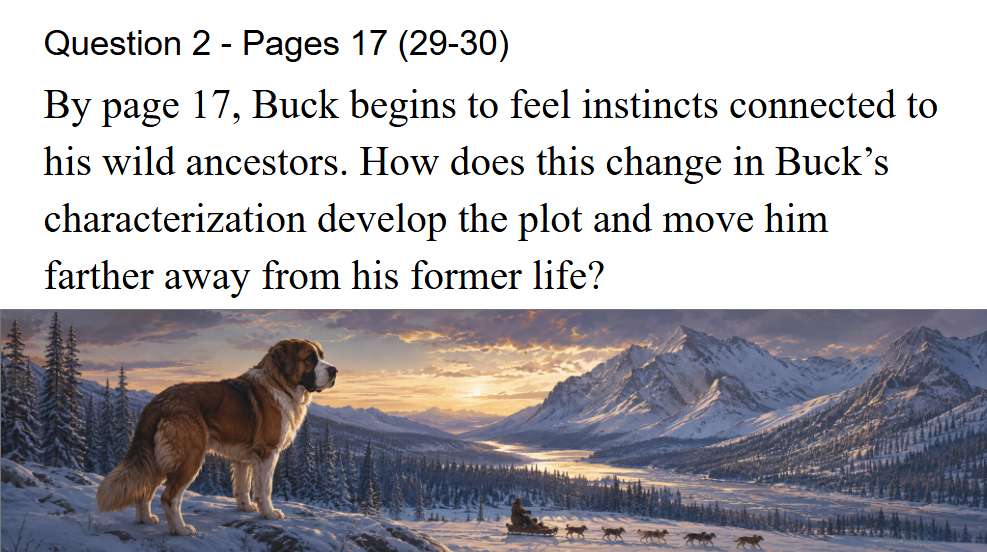
Buck, a large brown-and-black mixed-breed dog, looks across a snowy Alaskan mountain valley
Wordless daily visual for Call of the Wild
125students
6class sections
20protocol days
45 min15 read · 15 talk · 15 assess

The protocol served approximately 125 students across six sections over 20 instructional days. Each 45-minute lesson allocated 15 minutes each to reading, discussion, and an independent check. These are teacher-reported implementation figures.

01 · READ

Keep the chunk human-sized.

Students read pages 13–17. Across the unit, each 45-minute daily cycle reserves 15 minutes for reading before students move into talk and independent assessment.

02 · TALK

Make interpretation social.

Small-group prompts require students to explain how setting shapes Buck’s actions and how ancestral instinct changes characterization and plot. The early sequence centers on literary elements before the unit expands into vocabulary, figurative language, and theme.

03 · ASSESS

Measure transfer independently.

The saved Day 4 Google Form contains four four-choice items and one five-option, choose-two item, followed by student feedback on difficulty, fairness, and perceived FAST practice value. Other planned protocols include EBSR; this saved Form does not.

One day, by design

A visible line from text to evidence.

Every component returns students to the same benchmark rather than treating reading, discussion, and assessment as separate activities.

  • Focus: Grade 8 literary elements
  • Item progression: setting → behavior → plot → ancestral instinct
Teacher-facing implementation sample

A lesson another teacher can pick up.

Audience: Grade 8 ELA. Purpose: connect the northern setting, Buck’s changing behavior, and plot development. The Day 4 focus is ELA.8.R.1.1. Use pages 13–17 in the unit edition; confirm the corresponding passage in another edition.

The discussion prompts and assessment examples come from saved materials. The facilitation, differentiation, and response guidance below is newly assembled for this portfolio, not represented as an original teacher manual.

Unit progression without the wall-sized pacing map

The available unit outline moves from adaptation and literary elements into conflict, vocabulary in context, author’s craft, loyalty, and culminating theme analysis. It is a selected progression, not a verified 20-day calendar.

SequenceEvidence availableInstructional thread
Opening · pp. 1–3, 4–8, 9–12, 13–17Author-confirmed ranges; saved Day 4 Form and discussion imagesSetting, adaptation, characterization, and plot; Day 4: ELA.8.R.1.1
Conflict and survivalAuthor-supplied outline; not all daily artifacts recoveredLiterary elements and theme; pages 30–37 confirmed as a protocol chunk, details not recovered
Vocabulary and craftOutline identifies pp. 42–45 and 45–50ELA.8.V.1.3 and ELA.8.R.3.1
Loyalty and transformationOutline through pp. 70–76Recurring literary-elements and theme work; compare themes across the ending
Prepare, facilitate, and collect independent evidence
Before the lesson

Use the class edition to locate the reading in Chapter II: survival routines, food theft, physical adaptation, and ancestral instincts. Check that students can access the same passage, discussion prompts, and five-question check. Page numbers vary by edition. Prepare a private response roster; do not collect student identities in a public portfolio form.

0–15 minutes · reading

Students read the assigned section. Ask them to notice a chain: environmental pressure → Buck’s response → consequence. Briefly clarify directions and necessary vocabulary without supplying the assessment answers.

15–30 minutes · student talk

Use the two saved prompts below. Ask students to point to the text, hear a peer’s interpretation, and explain or revise their thinking. These are oral discussion prompts, not written-response assignments.

  1. How does the harsh northern setting force Buck to change on pages 15–16? Use at least two specific examples from the text to explain how the environment affects his actions.
  2. By page 17, Buck begins to feel instincts connected to his wild ancestors. How does this change in Buck’s characterization develop the plot and move him farther away from his former life?
30–45 minutes · independent assessment

Students answer independently with the text available. The saved Form includes four multiple-choice questions and one choose-two multiselect, followed by difficulty, fairness, and perceived practice-value ratings. Keep those ratings separate from comprehension scores.

Inspect an authentic Day 4 item and its evidence

Original saved Form question; answer analysis prepared for the portfolio.

Why is Buck’s theft of the bacon on page 15 an important event in his development?
  1. It proves that Buck has become the leader of the dog team.
  2. It demonstrates that Buck has learned his behavior from Dub.
  3. It shows that Buck no longer fears punishment from humans and is willing to break the rules.
  4. It shows that Buck is beginning to abandon the rules of his former life when survival requires it.

Portfolio key: D. The event connects the demand for survival to a change in Buck’s behavior. A jumps ahead to leadership; B misattributes the model for the behavior; C overstates the disappearance of fear. This is a component of literary-elements analysis; the discussion extends the connection to setting and plot.

The downloadable sample includes all five saved assessment items, the two discussion prompts, and separate teacher key notes. It contains no student responses, names, or modern copyrighted passage reproduction.

Differentiation and the next instructional decision

Proposed access supports: chunk the reading at natural pauses; offer an accessible digital text and approved audio support where appropriate; preview a small number of non-target words; provide an oral frame such as “The setting makes Buck ___, which leads to ___.” Follow individual accommodation plans and preserve the intended reading construct.

Extend: ask students to compare Buck’s earlier rule-following with his new choices, or test a competing interpretation using evidence. Keep the challenge in the reasoning rather than in extra volume.

Respond: if students recognize the event but miss its significance, model an event → character-change connection using a different moment. If they choose a valid answer plus an unsupported option, rehearse checking each choice independently. If difficulty ratings are high despite accurate responses, examine pacing and clarity before lowering rigor.

Recheck: use a fresh, short item on the next reading chunk. This is an implementation recommendation, not a claim of measured intervention impact.

One protocol. Three moments for students to think.

The system gives students 15 minutes to read, 15 minutes to test ideas with peers, and 15 minutes to demonstrate independent thinking. It also gives the teacher a quick, standards-specific signal for the next day.

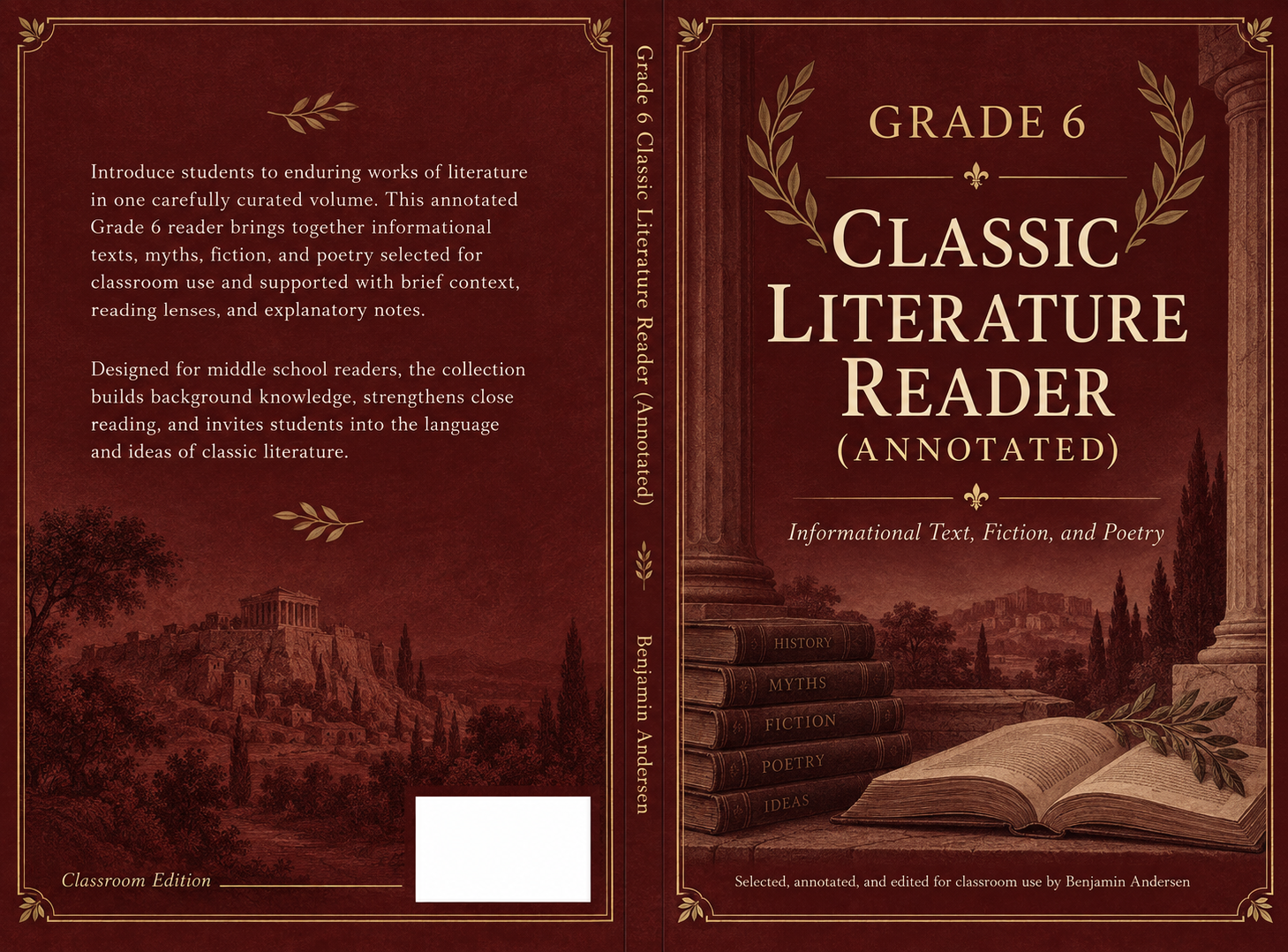
Full wraparound burgundy cover for the Grade 6 Classic Literature Reader, including the back cover, spine, and front cover
Final Grade 6 KDP cover · complete wraparound production file
Publishing case study

From an instructional gap to a three-volume series.

Students needed dependable access to challenging, classroom-ready texts. I developed a Grade 6–8 series that combines carefully sourced literature with the context, annotation, and visual structure middle-school readers need—without turning the books into workbooks.

3published grade-level volumes
6–8middle-school grade band
6 × 9print-ready interiors
01 · SELECT

Begin with instructional purpose.

I evaluated texts for grade-level rigor, Florida B.E.S.T. connections, adopted-curriculum provenance, completeness, and classroom value. Each inclusion had to earn its place.

02 · EDIT

Add support without replacing thought.

Original Context and Reading Lens introductions, explanatory notes, paragraph numbering, and poetry line numbering help students enter complex texts while preserving the author’s work.

03 · PRODUCE

Treat quality control as content work.

I completed source-and-rights audits, table-of-contents and pagination checks, typography review, embedded-font preflight, cover geometry, and page-by-page visual QA before publication.

Inside the Grade 6 reader

See the editorial layer on the page.

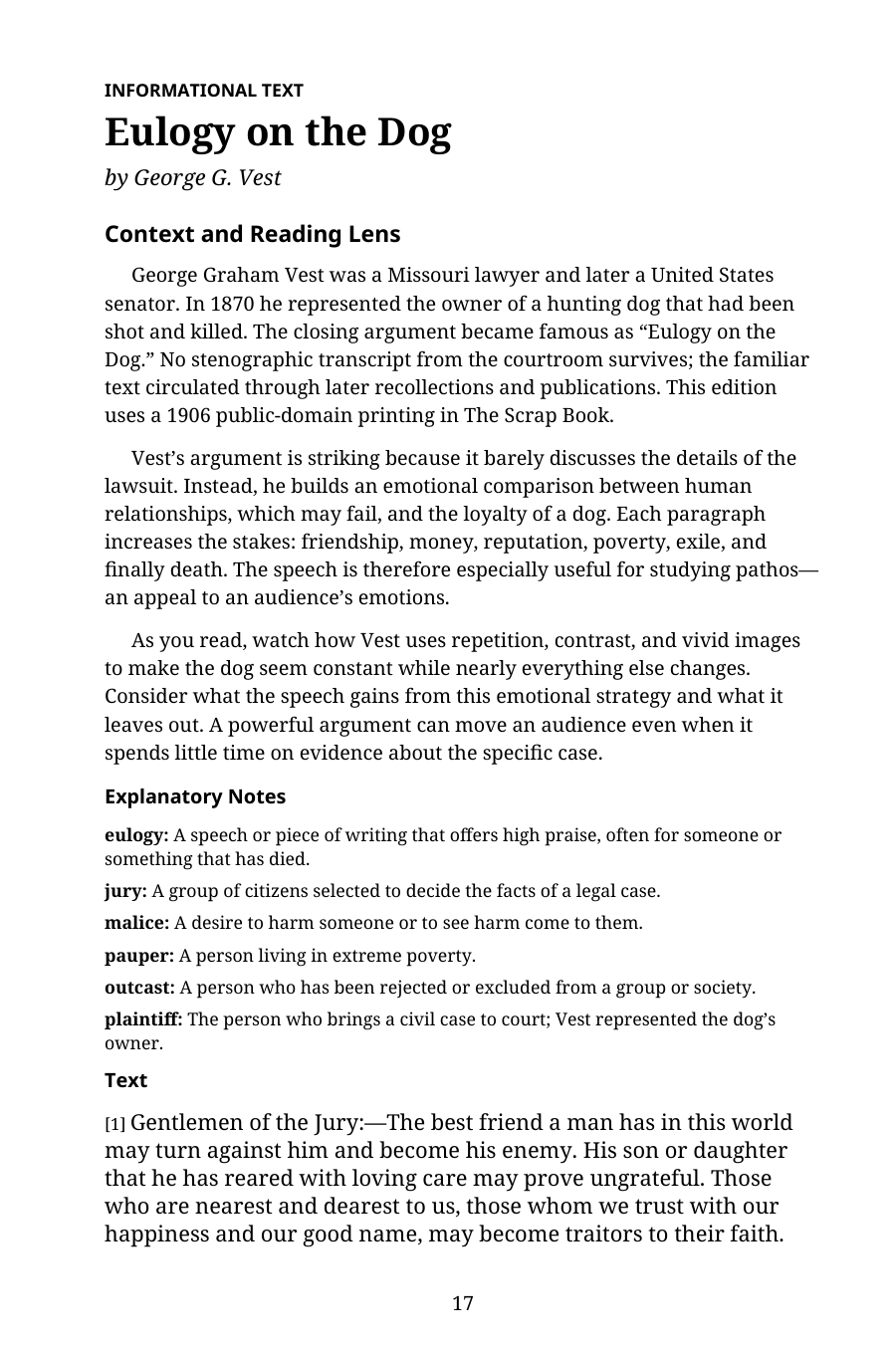
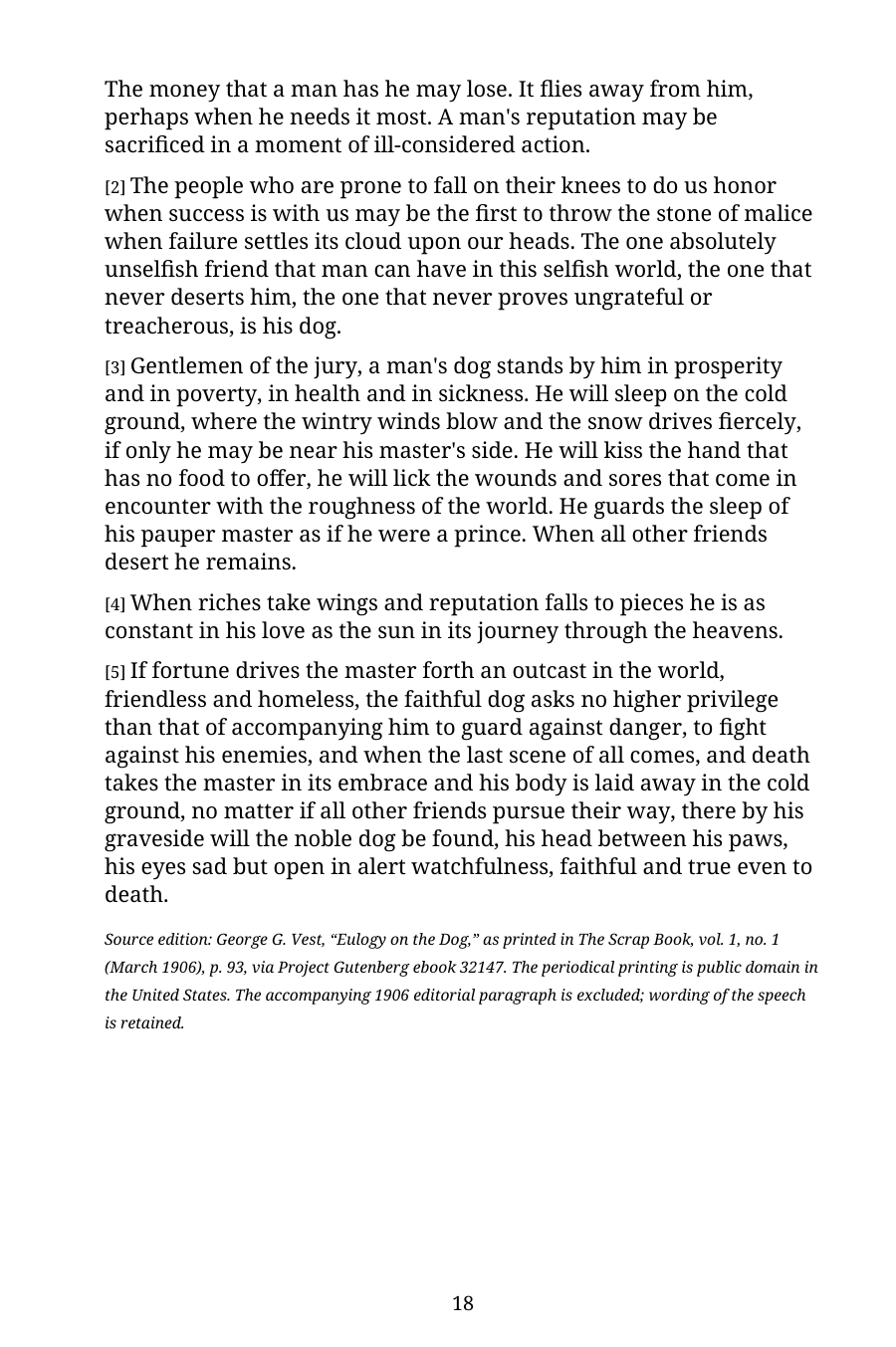
These consecutive pages from the final Grade 6 interior manuscript pair my original Context and Reading Lens and explanatory notes with George G. Vest’s public-domain speech. Paragraph numbers support discussion and reference; the continuation ends with a source-edition note. Open either page at full size to inspect the typography and editorial decisions.

Grade 6 reader page 17 showing the original Context and Reading Lens, explanatory vocabulary notes, and the opening of Eulogy on the Dog
Page 17 · Context, reading lens, and explanatory notes. View full size ↗
Grade 6 reader page 18 showing numbered speech paragraphs and a source-edition citation
Page 18 · Numbered text and source-edition record. View full size ↗
THE RESULT

A repeatable editorial system—not three isolated books.

03 / PROFESSIONAL LEARNING

Instructional Design & Professional Learning

Original projects from my earlier portfolio: practical learning for educators, supported by clear sequencing, usable explanations, and purposeful media. These samples complement the assessment and curriculum work above.

Rise 360 · staff learning

Using student data

Need: help school staff find and interpret data in Castle. I worked with district-level experts on an outline and built an asynchronous overview intended to take less than 30 minutes.

Deliverable: a Rise 360 course. Transferable work: subject-matter collaboration, task sequencing, and translating data procedures into teacher-facing instruction.

Open original Rise course ↗

Historical interface sample; not current Castle training. Original project context.

Rise 360 · new educators

Acronyms in education

Need: help new teachers understand the shorthand they encounter in meetings. Drawing on mentoring experience, I built a short course introducing common education acronyms.

Deliverable: a Rise 360 onboarding sample. Transferable work: learner-centered explanation, terminology support, and focused onboarding content.

Open original Rise course ↗

Original project context.

Articulate Storyline · skills demonstration

Hurricane plans

Need: demonstrate an interactive presentation around hurricane preparation. I built the Storyline sample using transitions, animation, layers, and links to outside resources.

Deliverable: an interactive authoring sample. Transferable work: layered information, navigation, and multimedia sequencing. No deployment or learner-outcome claim is made.

Open original Storyline sample ↗

Historical design sample, not current emergency guidance. Original project context.

Google Sites · employee onboarding

A starting point for new staff

Need: give new staff a place to find onboarding materials. I built a Google Sites hub combining a required handbook activity, important documents, and video instruction.

Deliverable: an onboarding website. Transferable work: information organization, procedural guidance, and a coherent entry point for multiple resources.

View original project gallery ↗

Gallery only. The underlying staff site is not shared because it may contain private information.

These projects were documented in 2022. Original landing pages and course endpoints were retrieved during this review; full interactive playback has not been browser-tested. No completion, satisfaction, or performance outcomes are claimed.

04 / EXPERIENCE

Educator. Editor. Team leader.

Classroom credibility is the foundation. Editorial experience sharpens the product. Leadership experience brings the work to scale.

Lexington Middle School

Language Arts Department Chair and middle school ELA educator. Curriculum, assessment, gifted education, team leadership, mentoring, and school improvement.

Mergenthaler Vocational-Technical High School

Baltimore City educator teaching Civics and U.S. History.

Newspaper journalism

Six years as a writer, editor, and page designer—experience that still informs my approach to clarity, structure, deadlines, and audience.

Leadership across the work

  • Language Arts and Gifted department leadership
  • District Grade 8 ELA Leading & Learning Team
  • School leadership and School Improvement Plan development
  • District textbook-adoption work
  • School Advisory Council Chair
  • Mentor teacher and FGCU cooperating teacher
05 / CREDENTIALS

Preparation and recognition.

Education

M.S., Educational Leadership
Nova Southeastern University

B.A., History & International Relations
University of Delaware, 2004

Florida credentials

English 6–12 · Reading K–12 · Social Sciences 6–12 · Educational Leadership · Gifted Endorsement · Civics Seal of Excellence

Recognition

High Impact Teacher, 2023–24 and 2024–25 · Golden Apple finalist · Teacher of Distinction

Let’s connect

Good educational content has to survive contact with reality.

I’m interested in assessment, curriculum, literacy, instructional design, and content-development work where precision and classroom usability matter.